Introduction
A critical communication gap plagues industrial manufacturing: marketing teams promote product durability and precision, while the supply chain struggles with vague specifications. This disconnect leads to production errors, delayed deliveries, and brand reputation damage. The root cause isn’t a lack of manufacturing skill, but a distortion of requirements as they pass from marketing to engineering to the factory floor.
Vague terms like “high precision” or “durable weld” are interpreted differently at each stage, leading to costly mismatches between market promises and manufactured reality. This article provides a clear framework for industrial marketers and content creators. Using precision laser welding service as a case study, it demonstrates how to translate complex technical specifications into unambiguous language, ensuring that marketing claims are perfectly executed in production, reducing errors and strengthening trust.
Why Are Terms Like “High Precision” and “Durable Weld” So Often Misinterpreted in the Supply Chain?
The journey from a marketing claim to a finished part is fraught with linguistic peril. Terms that seem definitive in a brochure become ambiguous blueprints, leading to inconsistent outcomes, rework, and cost overruns. The core problem is the subjective nature of language without quantifiable anchors in the manufacturing process.
1. The Subjectivity of Precision: Marketing vs. The Machine Floor
To a marketer, “high precision” conveys quality and excellence. To a design engineer, it might mean a tolerance of ±0.1mm. On the shop floor, a machinist might default to a standard ±0.5mm tolerance unless explicitly instructed otherwise. This disconnect means a part can be “precise” in three different ways, with only one meeting the unstated, true requirement. This ambiguity is the primary seed of production errors in OEM manufacturing.
2. Durability as a Function, Not a Feeling
Similarly, a “durable weld” is a qualitative assertion. Does it mean the weld can withstand 100,000 fatigue cycles? Or that it passes a specific bend test per ASTM E190? Without linking the claim to a verifiable, quantitative standard, the supply chain lacks a target. The welder’s “good enough” may be far from the engineer’s “to specification,” and both may fail the customer’s real-world application, damaging the brand built by industrial influencers.
3. The Cost of Ambiguity in the Communication Chain
The financial impact is severe. A vague requirement forces the supplier to make assumptions. If the assumption is wrong, the error is often discovered late — during final assembly or, worse, in the field. This triggers a costly cycle of scrap, rework, expedited shipping, and potential warranty claims. Investing in clarity at the specification stage is the most cost-effective quality control measure a company can take.
What is the “Spec-Translation” Framework for Complex Manufacturing Processes Like Welding?
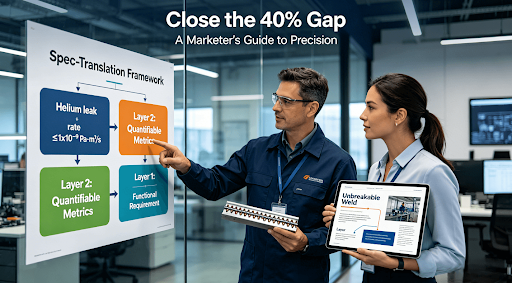
To eliminate ambiguity, marketers must master a structured “Spec-Translation” framework. This four-layer model systematically deconstructs a marketing need into a manufacturable, verifiable instruction set, creating a common language between all stakeholders and ensuring the final part performs as promised.
1. Layer 1: Articulating the Functional Requirement
Start with the “why.” This is the high-level, user-facing need. For a custom metal welding service, it could be: “The assembly must be hermetically sealed to hold a vacuum” or “The joint must not fail under 50kN of tensile load.” This layer defines the problem the part must solve, aligning marketing and engineering on the ultimate goal before discussing solutions.
2. Layer 2: Defining Quantifiable Performance Metrics
Translate the function into measurable data. For hermetic sealing, the metric could be: “Helium leak rate ≤ 1×10⁻⁹ Pa·m³/s.” For strength, it could be: “Weld must withstand 500,000 cycles at a 10kN dynamic load.” These metrics are the objective, numerical targets that replace subjective terms like “strong” or “leak-proof,” forming the basis for all subsequent engineering and quality control.
3. Layer 3: Specifying the Controlled Process Parameters
This layer dictates the “how.” To achieve the quantified metrics, specific welding process parameters must be defined. This includes laser power (e.g., 3kW), pulse frequency, welding speed, shielding gas type and flow rate, and joint preparation requirements. This is the detailed recipe that the manufacturing partner must follow, ensuring process consistency.
4. Layer 4: Mandating the Validation and Verification Methods
The final layer closes the loop: “How will we prove it?” This specifies the inspection and testing methods. It could require 100% visual inspection, X-ray testing for internal voids, destructive cross-sectioning (metallography) to verify penetration, or the aforementioned helium leak test. Defining the proof upfront ensures the delivered quality is objectively verified against the original marketing claim.
Which Content Formats Best Bridge the Gap Between Marketing Claims and Engineering Drawings?
Effective communication requires the right medium. Traditional 2D PDFs are insufficient for complex specifications. Modern industrial content creation must leverage interactive, visual, and standardized formats that prevent misinterpretation and create a shared understanding across technical and non-technical teams.
- Interactive 3D Models and Annotated PDFs: A 3D PDF or a model in a viewer allows stakeholders to interact with the design. Critical weld zones can be highlighted with callouts directly on the 3D geometry, specifying the required weld type, size, and performance metric for that exact location. This is far clearer than trying to locate a feature on a 2D drawing sheet, reducing errors in how to communicate welding specifications.
- Visual and Dynamic Media: Videos and Animated GIFs: A short video showing the correct welding sequence, torch angle, and desired weld pool behavior is invaluable. An animated GIF can illustrate the difference between an acceptable and an unacceptable weld bead profile. This visual training ensures the workshop understands the “good” standard, complementing written work instructions.
- Standardized Checklists and Digital Work Instructions: Complex specs are best managed with simple tools. A digitized checklist embedded in the manufacturing execution system (MES) can guide the operator step-by-step: “Step 4: Verify gas flow is 20 L/min. Step 5: Confirm laser is in pulsed mode at 100Hz.” This enforces the process parameters defined in Layer 3 of the translation framework, a practice aligned with NIST research on manufacturing interoperability and reducing human error.
How Can This Technical Clarity Become a Competitive Edge in Your “Manufacturing Technology Trends” Narrative?
In a crowded market, vague claims are ignored; demonstrable expertise attracts high-value clients. The structured, detailed approach to specification isn’t just an internal tool — it’s a powerful marketing asset. It allows you to move beyond talking about trends to showcasing how you master them, establishing thought leadership and tangible trust.
1. From Buzzwords to Evidence: Building Trust with Specifics
Instead of a generic post about “advanced precision welding technology,” publish a case study detailing the challenge: “Achieving a vacuum seal on a thin-walled titanium sensor housing.” Present the solution using the translation framework: the required leak rate (Layer 2), the specific pulsed laser parameters used (Layer 3), and the metallography images proving full penetration (Layer 4). This evidence-based content is infinitely more credible.
2. Content that Qualifies the Supply Chain
Use your detailed technical content to attract the right partners and repel the wrong ones. A supplier who can engage with the nuances of your welding quality standards blog post is likely a capable partner. This content acts as a filter, ensuring that inbound inquiries are from serious, quality-focused buyers who appreciate depth, aligning with sophisticated OEM social media strategies.
3. Establishing Authority in a Noisy Digital Landscape
By consistently publishing content that deconstructs complex manufacturing technology trends into actionable, specification-driven insights, you position your brand as an educator and authority. You become the go-to resource not just for products, but for the knowledge required to successfully execute demanding projects, a key differentiator in B2B marketing.
What Role Do Certifications Like IATF 16949 Play in This Communication Loop?
International certifications are more than badges; they are institutionalized communication and control systems. They provide a verifiable syntax that guarantees a supplier’s processes are designed to correctly interpret, execute, and validate complex specifications, making them a critical shorthand for capability in the marketing-to-manufacturing dialogue.
1. ISO 9001: The Foundation of Process Consistency
ISO 9001 certification ensures a company has a documented Quality Management System (QMS). This means there are controlled procedures for how your specification is received, reviewed, and translated into work instructions. It provides the basic assurance that processes are repeatable and deviations are tracked, forming the baseline for reliable communication.
2. IATF 16949 & AS9100D: The Language of Prevention and Traceability
IATF 16949 (automotive) and AS9100D (aerospace) enforce a preventive quality culture. They mandate rigorous Advanced Product Quality Planning (APQP), Failure Mode and Effects Analysis (FMEA), and full product traceability. A supplier with these certifications doesn’t just make a part; they proactively identify how your spec could be misunderstood or fail, and they build in controls to prevent it. Every part is linked to its raw material, machine data, and inspection results, creating an unbroken communication thread.
3. ISO 14001: Communicating Commitment to Sustainable Value
ISO 14001 certification for environmental management communicates a commitment beyond the product. It tells a story of responsible manufacturing — efficient energy use, waste reduction, and compliance. For marketers, this is a powerful narrative that resonates with ESG (Environmental, Social, and Governance) conscious clients, adding a layer of brand value to the technical specification.
How to Apply This Framework to Vet and Collaborate with “High Precision Welding Parts Manufacturers”?
The ultimate test of your communication framework is in supplier selection and collaboration. Use it as a live audit tool to separate transactional vendors from true engineering partners. The goal is to find a manufacturer whose dialogue demonstrates they think in the same structured, detail-oriented way as your framework demands.
- The RFQ as a Diagnostic Tool: When you send a request for quote, embed elements of the translation framework. Instead of just a drawing, include a key performance requirement (Layer 2). Observe the response. A qualified high precision welding parts manufacturer will not just return a price. They will ask clarifying questions about the test standard for that requirement, suggest optimal joint designs (DFM), and may even query the operating environment to ensure the spec is complete.
- Evaluating Collaborative Depth and Proactive Engagement: Assess the supplier’s willingness to engage in Design for Manufacturability (DFM). Do they provide a report that uses your framework? For instance: “To achieve your leak rate of 1×10⁻⁹ Pa·m³/s (Layer 2), we recommend a laser seam weld with these parameters (Layer 3) and will validate with helium mass spectrometry (Layer 4).” This proactive, analytical response signals a partner invested in your success, not just an order.
- Building a Partnership on a Foundation of Shared Language: The ideal outcome is a partnership where the framework becomes the shared language. Your marketing provides the Layer 1 “why,” your joint engineering defines Layers 2-4, and the manufacturer’s certified systems (IATF 16949, etc.) ensure flawless execution and traceability. This alignment turns the metal welding service with certification from a cost center into a strategic extension of your brand’s promise, ensuring that every product delivered is a perfect reflection of your market message.
Conclusion
The greatest risk to an industrial brand is not a competitor’s campaign, but the internal fracture between market promise and manufacturing execution. By adopting a disciplined “Spec-Translation” framework, marketers can transform ambiguous claims into precise, actionable engineering instructions. This clarity slashes production errors, accelerates time-to-market, and builds unshakable customer trust. Ultimately, the ability to communicate complexity with precision is not just an operational advantage — it is the core of a credible, high-value industrial brand in the modern market.
FAQs
Q: We’re a small OEM. Is this level of detailed specification really necessary for prototype welding?
A: Yes, especially for prototypes. Clear specs during the custom welding service for prototypes phase establish the quality and cost baseline. Vague requirements cause multiple, expensive redesign loops. Defining precise metrics from the first build creates a valid test article, accelerates development, and provides accurate data for scaling production efficiently.
Q: As a marketer, I’m not an engineer. How can I possibly define things like weld penetration depth?
A: Your role is to define the required outcome(e.g., “withstand X load” or “seal against Y pressure”), not the technical method. Use the translation framework: provide the functional requirement (Layer 1) and performance metric (Layer 2). A competent engineering partner or manufacturer will then specify the correct penetration depth (Layer 3) to meet your stated goals.
Q: Are certifications like IATF 16949 just for automotive companies, and why should I care?
A: IATF 16949 represents the pinnacle of preventive quality management, mandating FMEA, statistical control, and traceability. For any OEM, a supplier with this certification demonstrates a systemic, data-driven approach to error prevention. It guarantees that your “precision” claims are met consistently, batch after batch, providing essential supply chain risk mitigation.
Q: How do I find “high precision welding parts manufacturers” that can handle this level of technical dialogue?
A: Submit an RFQ that includes a key performance metric (not just a drawing). Qualified manufacturers will ask clarifying questions about test standards, operating environments, and provide DFM feedback. This proactive, analytical engagement — responding to the “why” behind the part — is the true marker of a capable high precision welding parts manufacturer.
Q: Won’t all this upfront specification and analysis slow us down and increase costs?
A: The opposite is true. Investment in clarity upfront is the most effective cost and time-saving measure. Ambiguity causes delays, scrap, and expedite fees. Clear specifications enable accurate quoting, faster setup, and right-first-time production, dramatically reducing the total cost and time-to-market, as supported by research on manufacturing interoperability.
Author Bio
The author is a manufacturing communications specialist focused on bridging the gap between advanced engineering and strategic marketing. The author, from LS Manufacturing, collaborates with teams that help OEM clients translate ambitious product visions into reliably manufactured reality, leveraging deep expertise in certified processes and structured technical dialogue. For a free, detailed DFM analysis of your welded component design, submit your project files for a comprehensive technical and feasibility review.
Stay in touch to get more updates & news on Influencersgonewild!