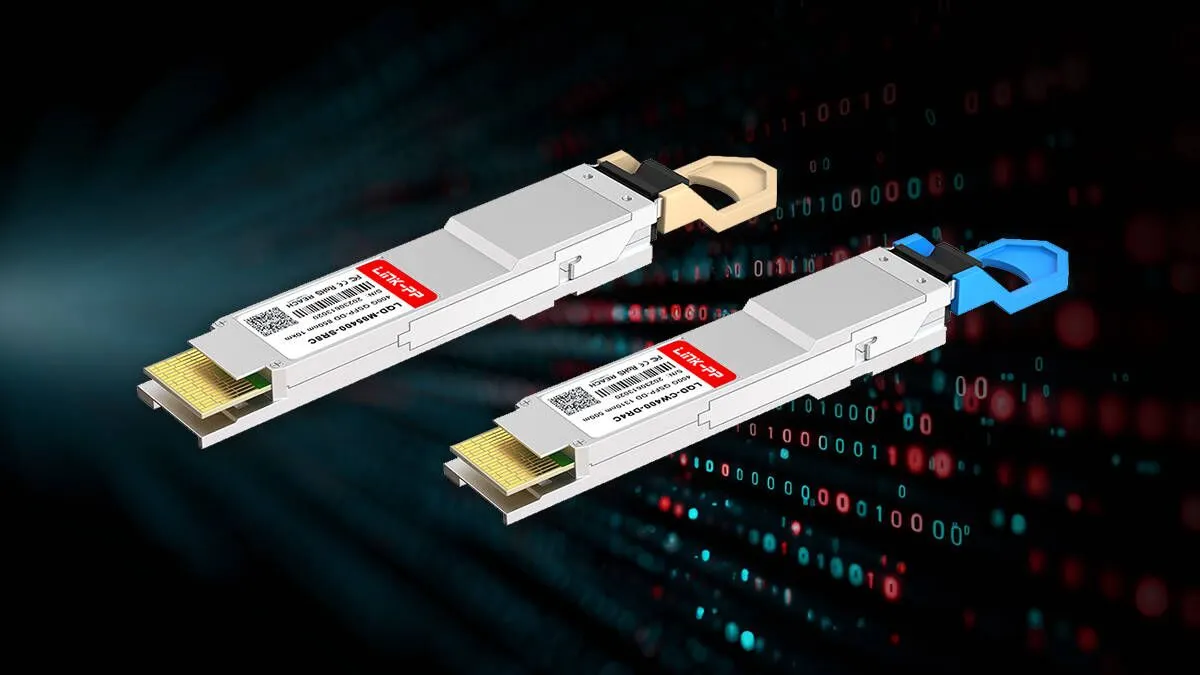
As data centers evolve to handle ever-growing traffic driven by cloud computing, AI training, and high-performance workloads, high-speed interconnects become increasingly crucial. The demand for 100G to 400G and beyond has pushed optical module technology toward new standards of performance and density. Three of the most popular module formats in today’s market are QSFP28, QSFP-DD, and OSFP. While all three serve high-speed data transmission needs, they differ in electrical lane count, size, power consumption, and upgrade potential. Understanding these differences helps network architects make the right choice for future-proof designs.
What is QSFP28?
QSFP28 (Quad Small Form-factor Pluggable 28) is a well-established standard widely used for 100G Ethernet. It builds on the older QSFP+ form factor, using four lanes, each operating at 25 Gbps, to provide a total line rate of 100 Gbps. QSFP28 maintains excellent backward compatibility with 40G QSFP+ ports, which made it the natural choice during the industry’s 40G-to-100G transition.
Physically compact and energy-efficient, QSFP28 modules are deployed mainly in 100G network backbones, high-performance computing, and aggregation layers. Common optical variants include 100G SR4, LR4, and CWDM4. Because of its manageable power profile (typically around 3.5 W per module), QSFP28 remains a cost-effective and reliable solution for legacy and mid-scale networks. However, as data demands surpass 100 Gbps per link, QSFP28 reaches its speed ceiling.
What is QSFP-DD?
QSFP-DD (Quad Small Form-Factor Pluggable – Double Density) represents the next evolutionary step. Like its name implies, Double Density doubles both the electrical and optical lane counts compared to QSFP28. It uses 8 electrical lanes, each supporting up to 25 Gbps NRZ or 50 Gbps PAM4, enabling total bandwidths of 200 Gbps or 400 Gbps per module.
Despite the increased performance, QSFP-DD retains mechanical backward compatibility with existing QSFP28 sockets, meaning that one network chassis can support both 100G and 400G modules depending on the cage and firmware design. This makes QSFP-DD a highly flexible platform for data center scaling.
In practice, 400G QSFP-DD FR4 optical modules have become a key building block for cloud-scale networks. The 400G FR4 variant uses four optical wavelengths transmitted over a single-mode fiber pair, supporting link distances up to 2 km. It provides an efficient transition path for operators upgrading their 100G QSFP28 infrastructures to 400G without redesigning rack layouts or cabling schemes.
Additionally, QSFP-DD maintains moderate power consumption (10–15 W for 400G models) and dense front-panel connectivity, fitting up to 36 ports per 1U switch, offering an aggregate throughput of 14.4 Tbps per rack unit.
What is OSFP?
OSFP (Octal Small Form-factor Pluggable) is another high-speed pluggable standard designed from the ground up for 400G and beyond, even up to 800G. Unlike QSFP-DD, OSFP is not backward-compatible with the QSFP form factor; it is slightly larger to accommodate higher thermal dissipation and more extensive electrical lanes (8 lanes of 50 Gbps PAM4 signaling by default).
The OSFP’s physical design can handle up to 15–18 W per module, providing thermal headroom for next-generation optics such as 400G ZR, 800G DR8, and future coherent modules. It supports air-flow–optimized heat sinks and integrated fins, making it particularly suitable for hyperscale AI clusters where link distances and data throughput demand stronger cooling capacity.
Although OSFP modules take more front-panel space (32 ports per 1U switch compared to QSFP-DD’s 36), they deliver higher performance and superior signal integrity, especially for applications exceeding 400G per port. Many large cloud operators favor OSFP for long-term scalability toward 800G and 1.6T networks.
Key Differences Among QSFP28, QSFP-DD, and OSFP
| Feature | QSFP28 | QSFP-DD | OSFP |
| Max Data Rate | 100 Gbps | 400 Gbps (up to 800 Gbps next-gen) | 400 Gbps and scalable to 800 Gbps+ |
| Electrical Lanes | 4 × 25 Gbps | 8 × 25 Gbps or 8 × 50 Gbps PAM4 | 8 × 50 Gbps PAM4 |
| Backward Compatible | With QSFP+ (40G) | With QSFP28 | Not backward compatible |
| Port Density (1U Switch) | 36–48 ports | 36 ports | 32 ports |
| Power Consumption | ~3.5 W | 10–15 W | 15–18 W |
| Thermal Capacity | Low | Moderate | High |
| Primary Applications | 100G datacenter, aggregation | 200G/400G switching, leaf–spine | 400G–800G hyperscale core interconnect |
| Typical Product | 100G LR4 / CWDM4 | 400G FR4, 400G DR4 | 400G ZR, 800G DR8 |
Each module family offers a balance between compatibility, performance, and upgradability. QSFP28 is best suited for legacy and mid-range deployments, QSFP-DD delivers high density and backward support for smooth migrations, while OSFP caters to cutting-edge, power-intensive infrastructures.
Migration Paths and Use Scenarios
Enterprises and cloud operators typically adopt a staged migration strategy. Networks running 100G QSFP28 infrastructure can move to 400G QSFP-DD FR4 modules using the same rack design and cabling footprint, minimizing operational disruption. For organizations with long-term plans for 800G, OSFP becomes the preferred route due to its forward scalability and thermal design.
Here are three representative scenarios:
- Enterprise Data Centers (100G Focused): Keep QSFP28 modules to balance cost and power efficiency.
- Cloud Aggregation Layers (100G to 400G Transition): Deploy QSFP-DD with 400G FR4 to quadruple bandwidth on existing QSFP-based systems.
- AI / HPC Clusters and Core Routers: Adopt OSFP for 400G–800G links, ensuring headroom for next-gen optics.
Conclusion
QSFP28, QSFP-DD, and OSFP reflect the evolution of optical transceiver technology in response to escalating network bandwidth requirements. Each format fits a specific role within modern data centers:
- QSFP28 delivers stable 100G connectivity with minimal power.
- QSFP-DD bridges the gap to 400G with backward compatibility and excellent density, especially with 400G FR4 optics.
- OSFP pushes beyond 400G, offering scalability for tomorrow’s ultra-high-speed networks.
In choosing between them, network planners should weigh factors like upgrade cost, port density, power budget, and thermal design. Ultimately, these module standards coexist — each optimized for different stages of the data center evolution toward Terabit-scale connectivity.
Stay in touch to get more updates & news on Influencersgonewild!