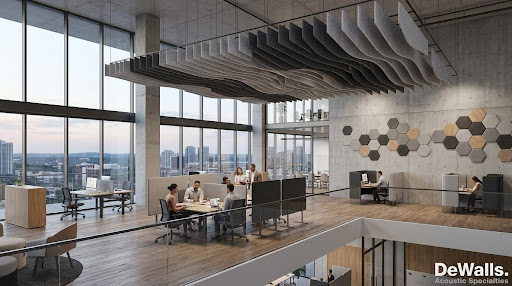
Acoustic design improves employee productivity in Texas offices by fixing the two biggest noise problems in the state’s newest buildings: sound bouncing off glass and concrete, and the loss of speech privacy in open floor plans. Sound-absorbing materials, sound masking systems, and zoned layouts solve both issues at the same time. Employees get the quiet they need for focused work and the privacy they need for calls, without losing the collaboration open offices were designed for.
That is the short answer. Here is the longer one, and why it matters more in Texas right now than it did five years ago.
Why Texas Offices Have a Bigger Noise Problem Than Most
Texas has been building office space faster than almost anywhere else in the country. Dallas alone had roughly 2.6 million square feet of office space under construction in early 2026, with Austin and Houston adding significant volume on top of that. Together, the three metros accounted for close to two-thirds of all office construction across the entire southern United States, according to Yardi Matrix data reported by Commercial Cafe.
Most of that new space follows the same design formula:
- Glass curtain walls.
- Exposed concrete floors and ceilings.
- Open floor plans with few interior walls.
- High ceilings with minimal sound absorption.
It photographs beautifully. It also reflects sound instead of absorbing it. Every phone call, meeting, and hallway conversation carries further and lasts longer than it would in an older, more compartmentalized building.
Three forces are driving this problem at the same time:
- Rapid construction. New Texas office towers are being built faster than almost anywhere in the country, and most follow the same glass-and-concrete style.
- Return-to-office momentum. Governor Greg Abbott ordered state agencies to end remote work in March 2025. The mandate applied to government workers, not private companies, but it set a cultural tone that many Texas employers followed.
- Flight to quality. Companies are leaving older buildings for newer towers, and tenants like Bank of America and NRG Energy have both relocated to upgraded buildings in Dallas and Houston in recent years.
That last point matters more than it first appears. Newer does not always mean quieter. Many of these trophy buildings use the exact glass-and-concrete style that amplifies noise instead of controlling it. Paying a premium for a modern office does not automatically buy acoustic comfort. Office acoustics have to be planned in separately, the same way lighting or HVAC would be.
What Bad Acoustics Actually Cost You
It is tempting to treat noise as a minor annoyance. The research says otherwise.
Here is what the data shows:
- Lost focus time. A widely cited 2014 study from Steelcase and Ipsos found that office workers lose as much as 86 minutes a day to noise-related distractions.
- Slow recovery. Research from Gloria Mark at UC Irvine found that it takes an average of over 23 minutes to fully return to a task after an interruption. Most people do not go straight back to what they were doing. They drift through one or two other tasks first, which stretches the real cost even further.
- Speech is the worst offender. Studies on open-plan offices have found that overheard conversation is the single most disruptive type of noise. A nearby conversation alone can cut a person’s productivity on a task by as much as two-thirds while it is happening.
- Privacy dissatisfaction. Researchers at the University of Sydney found that a lack of speech privacy is one of the biggest sources of dissatisfaction in open offices, ranking above almost every other environmental complaint employees raise.
Now put that in a Texas context. Average office asking rents run:
- Austin: around $45 per square foot.
- Dallas: around $32 per square foot.
- Houston: around $27 per square foot.
These figures come from recent Colliers and Commercial Property Executive data. Every one of those square feet is being paid for whether or not the people sitting in it can actually concentrate. A company leasing space in a loud, echo-prone building is effectively paying premium rent for reduced output.
That math also changes the retention conversation:
- Austin’s office vacancy has hovered between 22 and 27 percent through 2026.
- Job growth in tech and finance keeps climbing at the same time.
- Companies are competing hard for talent in a market where employees have options.
A workplace that leaves people mentally drained by mid-afternoon because of constant noise does not help the case for coming back to the office five days a week.
The Three Mechanisms Behind Effective Acoustic Design
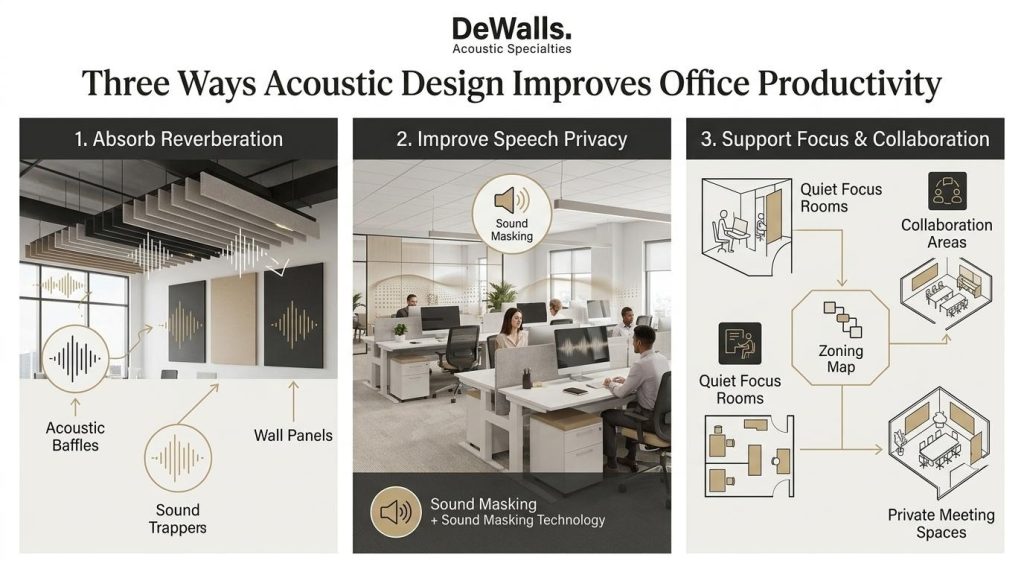
Most acoustic guidance comes down to three moves. They are not new ideas, but the way they apply to Texas buildings specifically is where most generic advice falls short.
- Absorbing and containing reverberation. Hard, reflective surfaces such as glass, polished concrete, and exposed steel bounce sound around a room instead of absorbing it. Acoustic ceiling baffles, wall panels, and floor treatments trap that sound energy before it travels. Ceiling treatment usually delivers the biggest single improvement, since ceilings tend to be the largest continuous reflective surface in any room.
- Sound masking for speech privacy. A sound masking system plays a steady, low-level background sound engineered to sit in the same frequency range as human speech. It does not drown conversations out. It makes them blend into a soft hum a few desks away instead of carrying as intelligible words.
- Zoning the layout around how people actually work. Not every task needs silence, and not every conversation needs to happen at a desk. Splitting a floor plan into focus zones, collaboration zones, and phone-booth-style private spaces lets each type of work happen where it belongs.
Why “Just Add Some Panels” Advice Falls Short in Texas
A lot of acoustic content treats these three mechanisms as interchangeable and stops there. Two things specific to Texas offices mean that is not enough:
- HVAC load. Texas buildings run cooling systems hard for most of the year, and that constant airflow adds a steady layer of background noise that most acoustic articles never mention, because it is not as significant a factor in milder climates. That background hum raises the baseline noise level before anyone has said a word.
- Leased space restrictions. A large share of Texas office tenants leases rather than own, and landlords in flight-to-quality buildings are often protective of finishes, ceiling grids, and glass systems. That rules out permanent structural changes in many cases, which is exactly why sound masking technology, installed above the ceiling rather than bolted to a wall, tends to be the most realistic first move for tenants who do not control the building shell.
A Three-Tier Framework for Fixing Texas Office Acoustics
Rather than treating acoustic design as a single purchase, think in tiers, moving from the building itself down to the technology layer.
Tier 1: The Envelope
- What it includes: ceiling baffles, acoustic wall assemblies, glazing treatments such as laminated glass or acoustic-rated window film.
- Why it works: it changes how sound behaves in the room at the source.
- Trade-off: usually requires landlord sign-off in leased space and carries the highest upfront cost.
Tier 2: The Layout
- What it includes: focus rooms, huddle spaces, enclosed phone booths.
- Why it works: it doubles as a space-planning decision, not just a comfort upgrade.
- Trade-off: a well-placed quiet room earns its rent back by making the rest of the floor plan more usable, but it does take up square footage that could otherwise be desks.
Tier 3: Active Technology
- What it includes: sound masking systems installed above the ceiling.
- Why it works: requires no changes to walls, floors, or glass.
- Trade-off: it manages speech privacy but does not reduce reverberation on its own.
Working with an experienced commercial soundproofing team in Texas at this stage helps identify which tier actually fits a specific lease and budget before any money is spent. Most offices end up using a mix of all three tiers, weighted toward whichever level their lease and budget allow.
How This Plays Out by Industry
Not every Texas office has the same acoustic problem, because not every industry works the same way.
- Call centers and insurance back offices (Houston-heavy): deal with compliance exposure as much as comfort. An overheard conversation involving a customer’s health or payment information is not just distracting, it is a liability. Sound masking paired with workstation-height panels tends to matter most here.
- Energy trading floors (also Houston-heavy): loud by design, built for fast verbal communication across a room. The goal is not quiet. It is controlling reverberation so shouted information stays intelligible instead of turning into echo.
- Tech and startup offices (Austin-concentrated): lean hardest into open, collaborative layouts, which makes zoning the priority. Engineers and designers need a real option to retreat into a focus zone when deep work is required.
- Professional services, law, and finance firms (Dallas-common): depend on client confidentiality. Speech privacy in conference rooms and private offices is not optional here.
A Quick Way to Check Your Own Office
You do not need a consultant on-site to get a rough read on where your space stands. Walk through this checklist first:
- Look at the surfaces. Count how much of the room is glass, bare concrete, or exposed ceiling versus carpet, upholstery, and acoustic tile. More hard surface generally means more reverberation.
- Do the clap test. Clap once in the middle of the room and listen for how long the echo trails off. A sharp, ringing tail lasting more than a second or two signals poor sound absorption.
- Check ceiling height and material. Higher, harder ceilings reflect more sound and need more absorptive treatment to compensate.
- Track actual complaints. Ask a few employees, informally, whether noise affects their ability to focus or take private calls. Patterns matter more than any single opinion.
- Note your lease restrictions. Before planning fixes, confirm what your lease allows for wall, ceiling, or glass modifications. This determines which tier of the framework above is realistically available.
Frequently Asked Questions
Do I need landlord approval to install acoustic treatment in a leased Texas office? It depends on the fix. Ceiling baffles, wall panels, and glass film often need sign-off since they touch the building’s finishes. Sound masking systems, installed above a drop ceiling, typically do not alter the building shell and rarely need approval.
How much does commercial soundproofing cost in Texas? Cost depends on square footage and the tier of solution chosen. Sound masking is usually the lowest-cost, fastest option per square foot, while full wall and ceiling treatment costs more but delivers a more permanent result.
What is the difference between soundproofing and acoustic treatment? Soundproofing stops sound from passing between spaces. Acoustic treatment improves the sound quality inside a space by reducing echo and reverberation. Most offices need acoustic treatment more than true soundproofing.
Does sound masking work in an open office with no walls? Yes. Sound masking is built for open layouts. It raises ambient background sound just enough to make distant speech unintelligible, which is why it pairs well with open-plan Texas offices that cannot add walls.
How long does it take to notice a productivity difference after treatment? Most employees notice a difference in call clarity and concentration within the first few weeks. The effect compounds as fewer daily interruptions add up over time.
Can acoustic panels reduce office noise without ruining the design? Yes. Acoustic panels now come in a wide range of finishes, colors, and shapes, so they can absorb sound while still matching a modern office’s visual style.
Where to Go from Here
None of this requires ripping out a floor plan or signing off on a major capital project. A practical next step looks like this:
- Run the self-audit checklist above on your current space.
- Confirm what your lease allows before assuming a fix is off the table.
- Start with the tier that fits your budget and lease terms, usually sound masking if structural changes are not possible.
- Get a short walkthrough from a team experienced with Texas building stock before signing off on a redesign or a new lease.
A sound masking system alone, added above the ceiling in a leased space, solves a real portion of the speech-privacy problem without touching a single wall.