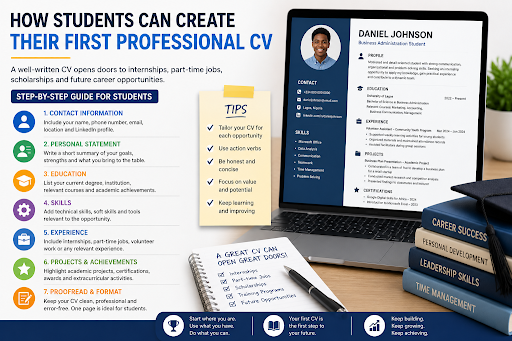
Creating your first professional CV as a student can feel difficult, especially when you do not have much work experience. Many students think a CV must be filled with full-time jobs, advanced skills, and years of achievements. In reality, a strong student CV is not about having a long career history. It is about presenting your education, skills, projects, activities, and potential in a clear and professional way.
Employers, internship coordinators, scholarship boards, and university programs understand that students are still building experience. What they want to see is effort, organization, communication skills, willingness to learn, and evidence that you can contribute.
A well-written CV helps you introduce yourself professionally. It shows who you are, what you have studied, what skills you have developed, and why you are ready for an opportunity. Whether you are applying for an internship, part-time job, scholarship, volunteer role, training program, or entry-level position, your first CV can open important doors.
This guide explains how students can create their first professional CV step by step.
What Is a CV?
A CV, or curriculum vitae, is a professional document that summarizes your education, skills, experience, achievements, and qualifications. It is used when applying for jobs, internships, academic programs, scholarships, volunteer opportunities, and career-related programs.
For students, a CV usually includes:
- Contact information
- Personal statement or professional summary
- Education
- Skills
- Projects
- Work experience, internships, or volunteer experience
- Certifications or training
- Achievements
- Extracurricular activities
- References, if required
Your CV should be easy to read, well-organized, and tailored to the opportunity you are applying for.
Why Students Need a Professional CV
A professional CV helps students compete for opportunities even without years of experience. It allows you to show your strengths beyond your academic results.
Students need a CV for:
- Internship applications
- Part-time jobs
- Graduate trainee programs
- Scholarships
- Volunteer roles
- Student leadership positions
- Industrial training placements
- Entry-level job applications
- Academic conferences or research opportunities
A good CV can help you stand out because it shows that you are serious, prepared, and able to present yourself professionally.
Step 1: Start With Your Contact Information
Your contact information should appear at the top of your CV. Keep it simple and professional.
Include:
- Full name
- Phone number
- Professional email address
- City and country
- LinkedIn profile, if available
- Portfolio or website, if relevant
Example:
Daniel Johnson
Lagos, Nigeria
+234 800 000 0000
[email protected]
linkedin.com/in/danieljohnson
Avoid using casual email addresses such as:
Use a professional email format, preferably your name.
Example:
Step 2: Write a Strong Personal Statement
A personal statement is a short paragraph at the beginning of your CV. It introduces who you are, what you are studying, your key strengths, and what kind of opportunity you are seeking.
Since students may not have much work experience, the personal statement is very important. It gives the reader a quick reason to continue reading.
Student CV personal statement example:
Motivated Business Administration student with strong communication, research, and organizational skills. Experienced in academic group projects, presentations, and basic data analysis. Seeking an internship opportunity where I can apply my knowledge, support business operations, and develop practical workplace experience.
Another example for a technology student:
Detail-oriented Computer Science student with foundational knowledge of HTML, CSS, JavaScript, and database management. Passionate about software development and problem-solving, with experience building academic projects and working in team-based assignments. Seeking an internship to gain practical experience in web development.
Your personal statement should be short, clear, and focused. Avoid writing a long life story.
Step 3: Add Your Education Section
For students, education is usually one of the strongest sections of the CV. Place it near the top, especially if you have limited work experience.
Include:
- Name of school, college, or university
- Course or degree
- Dates of study
- Relevant subjects or modules
- Academic achievements, if any
Example:
University of Lagos
Bachelor of Science in Computer Science
2022 – Present
Relevant coursework: Web Development, Database Systems, Data Structures, Software Engineering, Computer Networks
If you are still in school, you can write “Present” as the end date.
If you have a strong GPA or academic result, you may include it. If not, you can focus on relevant coursework, projects, and achievements instead.
Step 4: Include Relevant Skills
Your skills section helps employers quickly see what you can do. As a student, you can include skills gained from school, projects, volunteering, personal learning, or part-time work.
Divide your skills into categories if needed.
Example skills for students:
Technical Skills
- Microsoft Word
- Microsoft Excel
- PowerPoint
- Google Docs
- Canva
- HTML and CSS
- Basic data analysis
- Social media management
Soft Skills
- Communication
- Teamwork
- Problem-solving
- Time management
- Research
- Leadership
- Adaptability
- Attention to detail
Do not list skills you cannot explain. If you include “Excel,” be ready to describe what you can do with Excel. If you include “leadership,” be ready to give an example.
Step 5: Add Projects
Projects are very useful for students because they show practical ability, even when you do not have formal work experience.
You can include:
- Class projects
- Research projects
- Group assignments
- Personal projects
- Design projects
- Coding projects
- Business plans
- Presentations
- Community projects
Example:
Student Budgeting App — Academic Project
Developed a simple budgeting application concept as part of a group project. Conducted user research, created wireframes, and presented the final idea to classmates and lecturers. Improved teamwork, presentation, and problem-solving skills.
Another example:
Marketing Campaign Plan — Class Project
Created a social media campaign strategy for a fictional small business. Researched target customers, developed content ideas, and prepared a presentation explaining campaign goals, channels, and expected results.
Projects help prove that you can apply what you are learning.
Step 6: Include Work Experience, Even If It Is Small
Many students worry because they do not have formal work experience. However, experience does not always mean full-time employment.
You can include:
- Part-time jobs
- Internships
- Volunteer work
- Freelance work
- School assistant roles
- Campus leadership roles
- Personal business experience
- Family business support
- Community service
Example:
Sales Assistant — Part-Time
ABC Store, Lagos
June 2024 – September 2024
- Assisted customers with product selection and inquiries
- Organized shelves and maintained a clean sales area
- Processed simple transactions and supported daily store operations
- Developed communication, customer service, and teamwork skills
Even simple experience can show responsibility, reliability, and professionalism.
Step 7: Add Volunteer Experience
Volunteer experience is valuable, especially for students. It shows initiative, service, teamwork, and commitment.
Example:
Volunteer Tutor
Community Learning Program
January 2024 – April 2024
- Helped younger students improve reading and basic mathematics skills
- Prepared simple learning materials for weekly sessions
- Supported group activities and encouraged student participation
- Strengthened communication, patience, and mentoring skills
Volunteer work can be especially useful when applying for scholarships, internships, nonprofit roles, education programs, and community-focused opportunities.
Step 8: Include Certifications and Training
If you have completed online courses, workshops, or training programs, add them to your CV.
Examples include:
- Google Digital Skills training
- Microsoft Office certification
- Customer service training
- First aid training
- Coding bootcamp
- Digital marketing course
- Leadership training
- Data analysis course
- Language certification
Example:
Certifications
- Google Digital Skills for Africa — 2024
- Introduction to Project Management — Coursera, 2024
- Microsoft Excel Beginner Training — 2023
Certifications show that you are willing to learn beyond the classroom.
Step 9: Add Achievements
Achievements help make your CV more impressive. These can be academic, personal, leadership-based, or competition-related.
Examples:
- Won a school debate competition
- Served as class representative
- Completed a leadership program
- Earned a scholarship
- Led a student club project
- Organized a campus event
- Received academic recognition
- Participated in a science fair or business competition
Example:
Achievements
- Served as Class Representative for the 2023 academic session
- Selected as team leader for final-year group presentation
- Received recognition for outstanding participation in community service program
Do not ignore small achievements. If they show responsibility, discipline, leadership, or excellence, they can strengthen your CV.
Step 10: Include Extracurricular Activities
Extracurricular activities can help employers understand your interests and personality. They can also show transferable skills.
Examples:
- Student clubs
- Sports teams
- Debate society
- Press club
- Coding club
- Music group
- Volunteer organizations
- Entrepreneurship club
- Academic societies
Example:
Extracurricular Activities
- Member, Entrepreneurship Club
- Participant, University Debate Society
- Volunteer, Campus Environmental Clean-Up Team
These activities can show leadership, teamwork, communication, and initiative.
Step 11: Use a Clean and Professional CV Format
Your CV should be easy to read. Avoid overly colorful designs, too many fonts, or crowded layouts.
A student CV should usually be one page, especially if you are applying for internships or entry-level opportunities.
Use:
- Clear headings
- Short bullet points
- Simple fonts
- Consistent spacing
- Professional language
- Easy-to-read layout
Avoid:
- Too many colors
- Large graphics
- Unnecessary icons
- Long paragraphs
- Spelling mistakes
- Unprofessional email addresses
- Irrelevant personal details
A clean CV looks more professional and is easier for recruiters to review.
Step 12: Tailor Your CV to Each Opportunity
One mistake many students make is using the same CV for every application. A better approach is to adjust your CV based on the opportunity.
For example, if you are applying for a marketing internship, highlight:
- Social media skills
- Content creation
- Communication
- Research
- Marketing projects
- Canva or design tools
If you are applying for an IT internship, highlight:
- Programming languages
- Technical projects
- Problem-solving
- Software tools
- Database knowledge
If you are applying for a customer service role, highlight:
- Communication
- Patience
- Teamwork
- Problem-solving
- Volunteer or part-time experience
Tailoring your CV helps the employer quickly see why you are a good fit.
Step 13: Use Strong Action Words
Action words make your CV sound more professional. They help describe what you did clearly.
Good action words include:
- Assisted
- Created
- Organized
- Supported
- Researched
- Presented
- Managed
- Led
- Coordinated
- Developed
- Improved
- Participated
- Prepared
- Designed
Instead of writing:
Helped with a school project
Write:
Researched and presented findings for a group business project
Instead of:
Was part of a club
Write:
Participated in weekly club activities and supported event planning
Small wording changes can make your CV much stronger.
Step 14: Proofread Before Sending
A CV with spelling or grammar mistakes can create a poor impression. Before sending your CV, read it carefully.
Check for:
- Spelling mistakes
- Wrong dates
- Inconsistent formatting
- Missing contact details
- Incorrect phone number
- Unclear sentences
- Repeated words
- Overly long bullet points
You can also ask a friend, teacher, mentor, or family member to review it.
A polished CV shows attention to detail.
Student CV Example
Here is a simple example of how a first student CV can look:
Daniel Johnson
Lagos, Nigeria
+234 800 000 0000
[email protected]
linkedin.com/in/danieljohnson
Personal Statement
Motivated Business Administration student with strong communication, research, and teamwork skills. Experienced in academic group projects, presentations, and basic Microsoft Office tools. Seeking an internship opportunity to apply classroom knowledge, support business operations, and gain practical workplace experience.
Education
University of Lagos
Bachelor of Science in Business Administration
2022 – Present
Relevant coursework: Business Communication, Marketing Principles, Accounting, Entrepreneurship, Organizational Behavior
Skills
- Communication
- Teamwork
- Research
- Microsoft Word
- Microsoft Excel
- PowerPoint
- Time management
- Problem-solving
Projects
Business Plan Presentation — Academic Project
- Worked with a team of five students to create a business plan for a small retail startup
- Conducted market research and prepared competitor analysis
- Presented findings to classmates and lecturer
- Developed teamwork, research, and presentation skills
Volunteer Experience
Volunteer Assistant — Community Youth Program
March 2024 – June 2024
- Supported weekly learning activities for young students
- Helped organize materials and attendance records
- Assisted facilitators during group sessions
- Improved communication and organizational skills
Certifications
- Google Digital Skills for Africa — 2024
- Introduction to Microsoft Excel — 2023
Extracurricular Activities
- Member, Entrepreneurship Club
- Participant, Campus Debate Society
Common Mistakes Students Should Avoid
When creating your first CV, avoid these common errors:
1. Writing too much personal information
You do not need to include details such as religion, marital status, or unnecessary personal background unless specifically required in your country or application process.
2. Using an unprofessional email address
Your email should look serious and simple.
3. Making the CV too long
For most students, one page is enough.
4. Leaving out projects
Projects can help replace missing work experience. Do not ignore them.
5. Using vague descriptions
Avoid phrases like “hardworking student” without examples. Show proof through projects, activities, and achievements.
6. Sending the same CV everywhere
Always adjust your CV to match the opportunity.
7. Ignoring formatting
A poorly formatted CV can make good information look weak.
How MyCVCreator Can Help Students Build Their First CV
Creating your first CV from scratch can be confusing, but using a guided CV platform can make the process easier. MyCVCreator helps students and job seekers create professional CVs, resumes, cover letters, and career documents without starting from a blank page.
With MyCVCreator, students can organize their education, skills, projects, volunteer experience, and achievements into a clean professional format. This is especially useful for students who are applying for internships, scholarships, part-time jobs, or entry-level roles.
Instead of worrying about layout and structure, students can focus on presenting their strengths clearly.
Final Checklist for a Student CV
Before submitting your CV, make sure it includes:
- Professional contact information
- Short personal statement
- Education details
- Relevant skills
- Projects
- Work or volunteer experience
- Certifications or training
- Achievements
- Extracurricular activities
- Clean formatting
- No spelling mistakes
- Updated and correct information
A strong student CV does not need to be complicated. It simply needs to be clear, honest, organized, and relevant.
Final Thoughts
Creating your first professional CV as a student is an important step toward building your career. Even if you do not have formal work experience, you still have valuable things to include. Your education, skills, projects, volunteer work, certifications, achievements, and extracurricular activities can all help show your potential.
The key is to present your information professionally. Focus on what you have learned, what you have done, and what you are ready to contribute. Keep your CV simple, well-structured, and tailored to the opportunity you want.
Your first CV is not just a document. It is the beginning of your professional journey. With the right structure and preparation, you can create a CV that helps you apply with confidence and take your first step into the world of work.
Stay in touch to get more updates & news on Influencersgonewild!