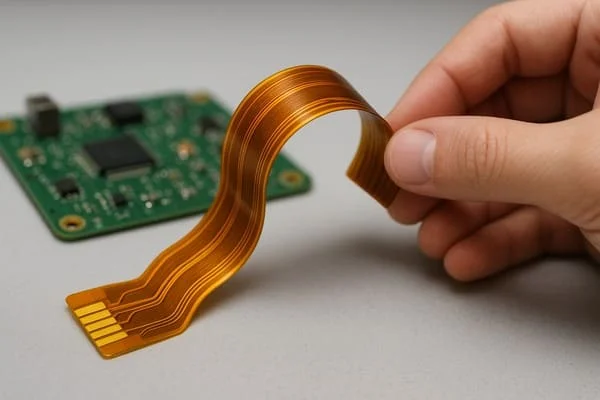
Anyone who has taken apart a smartphone, a wearable device, or a modern medical instrument has probably seen a thin, bendable circuit board tucked somewhere inside, often folded into a tight space that a rigid board simply could not fit into. That bendable circuit is a flexible printed circuit board, and it has quietly become one of the most important components enabling the compact electronics we now take for granted.
The Basic Problem Flexible PCBs Solve
Traditional rigid circuit boards work well for a lot of applications, but they have an obvious limitation. They are flat, stiff, and need to be mounted somewhere with enough open space to accommodate their shape. As devices have gotten smaller and more tightly packed with components, that constraint has become a real design bottleneck. Flexible PCBs solve this by allowing the circuit itself to bend, fold, or wrap around the internal geometry of a device, opening up design possibilities that a rigid board could never support.
Where Flexibility Actually Matters Most
Wearable technology is probably the clearest example. A fitness tracker or smartwatch needs to fit against the curve of a wrist, and a rigid circuit board would either force an awkward, bulky design or simply not fit at all. Medical devices face similar constraints, especially anything designed to be worn on or inserted into the body, where a flexible circuit can conform to a shape in ways a rigid one cannot.
Consumer electronics more broadly have also pushed toward flexible circuits as devices get thinner and more densely packed. Foldable phones are an obvious recent example, where the circuit itself needs to physically fold along with the screen without breaking or degrading over repeated use.
Reliability Under Repeated Movement
One of the more demanding requirements for flexible PCBs, particularly in foldable devices, is that they need to survive thousands or even tens of thousands of flex cycles without failing. This is a genuinely difficult engineering challenge, since repeated bending puts real mechanical stress on the copper traces and materials involved. Manufacturing processes for flexible circuits are built around minimizing that stress and choosing materials that can tolerate repeated movement without cracking or losing conductivity over time.
Space and Weight Savings Add Up
Beyond flexibility itself, these circuits often allow for meaningful space and weight savings compared to rigid alternatives, particularly when multiple rigid boards would otherwise need to be connected with separate wiring harnesses. A single flexible circuit can sometimes replace what would otherwise require several rigid boards and connectors, simplifying assembly and reducing the overall footprint of a device.
Manufacturing Complexity Is a Real Tradeoff
None of this comes without added complexity. Producing a reliable flexible circuit involves working with different materials and processes compared to standard rigid board manufacturing, and getting the process for flexible pcb manufacture right requires real expertise, particularly around material selection and how the circuit is laminated and protected against the mechanical stress of bending. This is part of why not every PCB manufacturer offers flexible circuit production, and why sourcing from a manufacturer with genuine experience in this specific area matters more than it might for a standard rigid board order.
Choosing the Right Approach for a Given Design
Flexible circuits are not automatically the right choice for every project. Rigid boards remain simpler and often more cost effective for applications where space is not a major constraint and repeated bending is not part of the design. The decision really comes down to whether a project’s physical constraints genuinely require the flexibility, or whether a standard rigid board would serve the same purpose at lower cost and complexity.
Where This Technology Is Headed
As devices continue to shrink and take on more unconventional shapes, from foldable screens to increasingly compact wearables, flexible circuit technology is likely to keep playing a growing role in how electronics get designed. Understanding both its genuine advantages and its added manufacturing complexity helps designers make a more informed choice about when it actually makes sense for a specific project, rather than treating it as a default upgrade for every design.