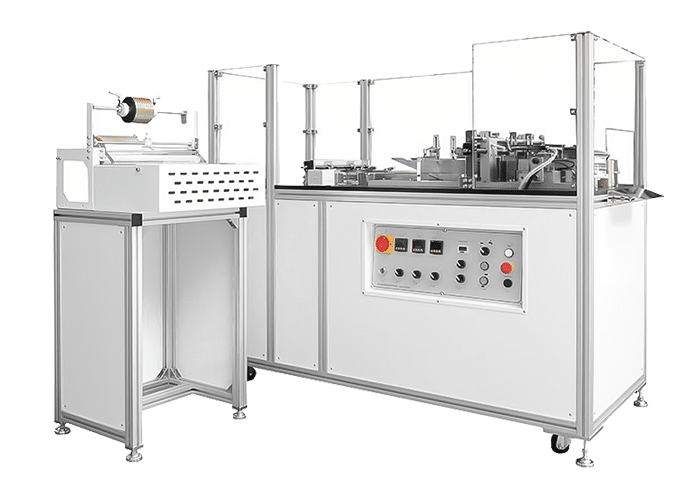
One of the more common questions a packaging manager faces when setting up or expanding a production line is what level of automation actually makes sense. It is tempting to assume that fully automatic equipment is always the better choice, but that is not really true. The right overwrapper depends on how many units a business ships, how much floor space is available, and how much the budget allows for right now versus later.
Manual Units for Low Volume Work
A manual overwrapper is operated by hand, with a worker feeding the product and film through the machine and triggering the seal. This sounds basic, and in a sense it is, but for a business packing a small or seasonal batch of items, it is often the most sensible option. There is very little to go wrong mechanically, the upfront cost is lower, and a worker can be trained on it within a day. Small workshops, artisanal food producers, and businesses trialing a new product line before committing to bigger volumes often start here.
Semi-Automatic Units as a Middle Step
A semi-automatic overwrapper takes over some of the repetitive motion while still relying on a person to load products and start each cycle. This is a natural step up for a business that has outgrown manual wrapping but is not yet ready for a full production line investment. It increases speed and consistency noticeably compared to hand wrapping, while keeping the machine simple enough that maintenance and training stay manageable. Many growing food and household goods producers sit in this category for a while before scaling further.
Fully Automatic Units for Volume Production
Once a business is running consistent, high volume output, a fully automatic overwrapper becomes the more sensible investment. These systems handle feeding, wrapping, and sealing with very little manual input, which cuts labor cost per unit and keeps output steady across long shifts. They are also built to integrate into an existing production line, syncing with conveyors and other equipment so that products move from filling straight through to a finished, wrapped state without a break in the process.
JOCHAMP produces all three types of overwrapper, which makes it easier for a business to be honest with itself about where it actually sits in terms of volume rather than overbuying or underbuying equipment. Their manual units are built for robustness and are suited to single items or small batches. The semi-automatic range strikes a balance between manual control and mechanical speed, described by the company as a practical improvement over hand wrapping for moderate volume needs. Their fully automatic line is positioned for high capacity operations that need precision and labor savings at the same time.
What to Actually Compare
When comparing options, it helps to look past the automation label and check a few concrete things. How fast does the film feed and seal, and does that speed match your actual daily target rather than a marketing number? What sealing method does it use, since some products need heat sealing while others do better with cold or glue based sealing depending on the material being wrapped? How easily can the machine size be adjusted if your packaging dimensions change down the line, since a rigid machine that only fits one box size can become a bottleneck the moment a product line expands?
It is also worth asking about lead time for parts and support, since even reliable machinery eventually needs a replacement component or a technician’s guidance. A machine that runs well for years but leaves you stuck when something does need attention is not actually the bargain it looked like on day one.
There is no universal right answer here. A business packing a few hundred units a week and one packing tens of thousands a day are simply solving different problems, and the smartest move is usually to buy for where your production actually is today, with a clear sense of how you would scale up when the time comes.