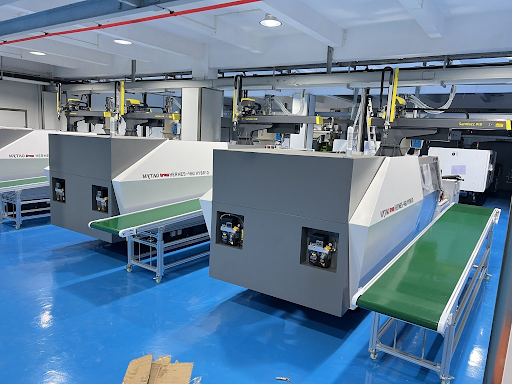
Many plastic part makers start in modest premises. Floor space is limited, machines are placed close together, and workers move around them all day. In such a workshop, every square metre matters and every unnecessary movement near a hot mold is a risk. This is one of the reasons people choose a vertical injection molding machine and then add a robot to take the finished parts away. Let us look at how this combination helps with space and safety.
Why Vertical Machines Are Chosen for Small Spaces
A vertical machine moves its mold up and down, so it stands tall instead of stretching out along the floor. For a workshop with a low floor area but enough ceiling height, this layout can be very practical. The trade off is that the working area is more compact, and there is less room to improvise around it.
This is where the arrangement of the robot becomes important. If a robot takes up too much room, the advantage of the compact machine is lost.
How a Robot Can Help Save Space
Samfacc, a manufacturer of robots for injection molding machines, states that its vertical robots are designed to take the finished product or material head from the end of the machine. The company says this saves placement space around the molding machine. It also describes combining vertical robot technology with arm robot functions to reduce the footprint of molding operations.
In practical terms, a robot that removes parts and puts them on a conveyor means you do not need a worker standing beside the machine with a table or bin. The part goes straight to the next place, and the area around the machine can be kept clearer.
Reducing Human Labour and Injury Risk
The manufacturer also states that its robots help reduce human labour and lower the risk of bodily injury. This is a sensible claim in general terms. Reaching into a mold area repeatedly exposes a worker to heat, moving parts and awkward postures. When a robot performs the repeated movement, people are needed less often in the most exposed spot.
It is important to understand what this does and does not mean. A robot reduces how often a person must reach into the machine. It does not remove the need for training, guards and safe procedures.
A Practical Safety Checklist
- Guards and doors. Keep protective guards in place and make sure interlocks work.
- Emergency stops. Every operator should know where they are and how to use them.
- Clear zones. Mark the area where the robot arm moves, and keep tools and bins out of it.
- Lockout before servicing. Switch off and isolate power before cleaning, adjusting or clearing a jam.
- Hot surfaces. Molds and freshly molded parts can be hot, so protective gloves may be needed.
- Training. Everyone who works near the machine should understand how the robot moves.
- Regular inspection. Check cables, fixings and moving parts for wear.
Planning the Layout
A good layout starts on paper. Draw the floor plan with the machine, the robot, the conveyor and any tables, material storage and walkways. Check that people can walk around safely, that there is room to open covers for maintenance, and that the conveyor leads to a sensible next step.
Think also about the height. Vertical machines already need ceiling clearance, and the robot adds to the arrangement. Measure carefully before you decide.
Questions Worth Asking a Supplier
- How much space does the robot need beside the machine?
- How does it mount, and does it work with my machine’s size and mold height?
- What safety devices come with it?
- Can the layout be adjusted to suit my workshop?
- What training and manuals are provided?
- How are spare parts and technical support handled?
The manufacturer says that its robots can be customized for specific applications, so it is reasonable to ask how this works for your own situation and to get the answers in writing.
Energy and Operating Cost
The same manufacturer also describes its robots as energy saving and cost effective. Since claims like these depend on use, treat them as a starting point. Ask for real data on power use, and compare it with your present working method before making a decision.
Where to Look Next
If you are planning a compact workshop and want to see what is available for a vertical injection molding machine, the manufacturer’s page lists its vertical robot range and describes how the robots are intended to work.
Final Thoughts
Space and safety are closely linked in a small workshop. A tidy layout, a robot that removes parts reliably and a team that follows safety rules can make production calmer and more predictable. Start with a careful plan, ask clear questions and choose equipment that fits your real needs.