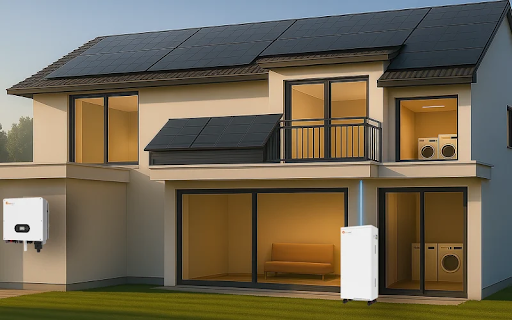
Buying a battery system for solar power can feel confusing at first. There are many model names, many sizes, and plenty of technical words. The good news is that you can make a sound decision by answering a short list of practical questions. This guide walks through them one by one, using the way solar energy storage solutions are organized by Felicitysolar as a helpful example.
Start with your daily energy use
Before you look at any product, look at your electricity bill or your meter. Find out how many kilowatt hours you use in a day. A kilowatt hour is simply the energy used by a one kilowatt device running for one hour. Then think about when that energy is used. If most of your use falls in the evening, a battery will be very valuable. If most of your use happens in daylight, you may need less storage and more panel capacity.
Next, list the devices that must keep working during an outage. Lights, fans, a refrigerator and phone chargers use little power. Air conditioners, water pumps and workshop machines use a lot. Knowing this list helps you choose the right inverter size, which is measured in watts or kilowatts, and the right battery size, which is measured in kilowatt hours.
Match the system size to your situation
Felicitysolar groups its energy storage offering into balcony, residential, commercial storage, and commercial and industrial categories. That grouping is a useful way to think about scale. A balcony system suits a small space and modest loads. A residential system is meant for a whole home. The commercial and industrial range covers businesses and factories.
The company also lists hybrid inverters in its IVGM series, described as covering 3 kW to 125 kW. A wide range like this means a buyer can often stay with one product family while the project grows. Staying within a family can make life easier, since the parts are designed to work together.
Check that the inverter and battery are a proper pair
A battery and an inverter must be compatible. Voltage, communication and control all need to line up. Solution pages are helpful here, because they usually name specific inverter and battery models that are intended to work together. For example, Felicitysolar lists a 50 kW commercial package that pairs the IVGM50KHP3G2 inverter with the FLH48100UG2 high voltage LFP battery, and a 125 kW package that pairs the IVGM125KHP3G1 inverter with the FLH48314UG1 battery. Seeing named pairs removes a lot of guesswork.
Look at cooling and safety
Batteries produce heat when they charge and discharge, so the way a system manages that heat matters. Larger systems often use either air cooling or liquid cooling. On its commercial and industrial page, Felicitysolar explains that liquid cooling uses circulating coolant to absorb and release heat and takes up less space and makes less noise than air cooling, while air cooling is simpler and cheaper for moderate demands. Neither is automatically better. The right choice depends on size, climate and budget.
Always ask what protections are built into the system. Look for a battery management system, and ask how faults are detected and reported.
Do not skip the support side
Good equipment still needs good support. Before buying, check whether the supplier provides manuals, datasheets and installation videos. Felicitysolar offers a download center, a video gallery and a service system for contacting engineers. Having these resources available makes installation and later maintenance far easier, whether you are an installer or a home owner.
It is also wise to confirm that the product you receive is genuine. The company provides an anti counterfeiting page where a 16 digit code on the product can be verified. If a supplier offers a similar check, use it.
Use planning tools
Some manufacturers give you a way to get a recommendation based on your details. Felicitysolar has a system configuration plan page, where you enter basic information and receive suggestions for products. A tool like this is not a replacement for a site visit by a qualified installer, but it is a good starting point and helps you ask better questions.
Think about monitoring
Once the system is running, you want to know what it is doing. A monitoring platform shows production, battery level and consumption. Felicitysolar describes its Fsolar platform as a way to monitor and manage solar energy at any time and from any place. Watching your numbers for a few weeks teaches you a lot about your own habits and shows where you can save.
Plan for growth
Energy needs usually rise over time. You may add an appliance, a second floor or a small business. Ask whether the battery can be expanded and whether the inverter can handle extra load. It is easier to plan for this at the start than to replace equipment later.
Final thoughts
Choosing storage does not need to be stressful. Know your daily use, decide which loads matter most, pick a size category that fits, confirm that the inverter and battery are a matched pair, and make sure there is real support behind the product. Take your time, ask questions, and compare more than one option. A careful choice today can serve you well for many years.